
Why World Building Isn’t Just “Decoration”—It’s the Heartbeat of Your Story
INK & SHADOWS
TL Hutton
2/22/20264 min read
Why World‑Building Isn’t Just “Decoration”—It’s the Heartbeat of Your Story
Hey writers, creators, and dream‑chasers! I’m knee‑deep in the dust and pine‑scented breezes of Tóshon Flats, AZ, the restless stage for my new novel “Where the Wind Cries Red.”
What I’m doing right now feels like archaeology meets imagination, and I wanted to pull back the curtain on why every tiny fragment of history matters—and why you should make it a non‑negotiable part of your own process.
A History Gives Your Characters Roots
When I dug up a lost journal from a 1932 prospector, a hand‑drawn map of the Mogollon River, and a clandestine government file about “Operation Coyote,” each piece whispered a different “why” to the people who live in my world.
—They’re not just props; they’re the reason my protagonists fear the wind, cherish the pine, and argue over the old radio frequency.
Sensory Reality = Reader Immersion
If I can feel the wind flirting with my skin, smell the pinon pines on a cold night, hear a crackling Tribal Radio broadcast at 3 am, then my readers will feel it too.
The more concrete the backdrop, the easier it is for a reader to drop their coffee mug, step into the scene, and stay there.
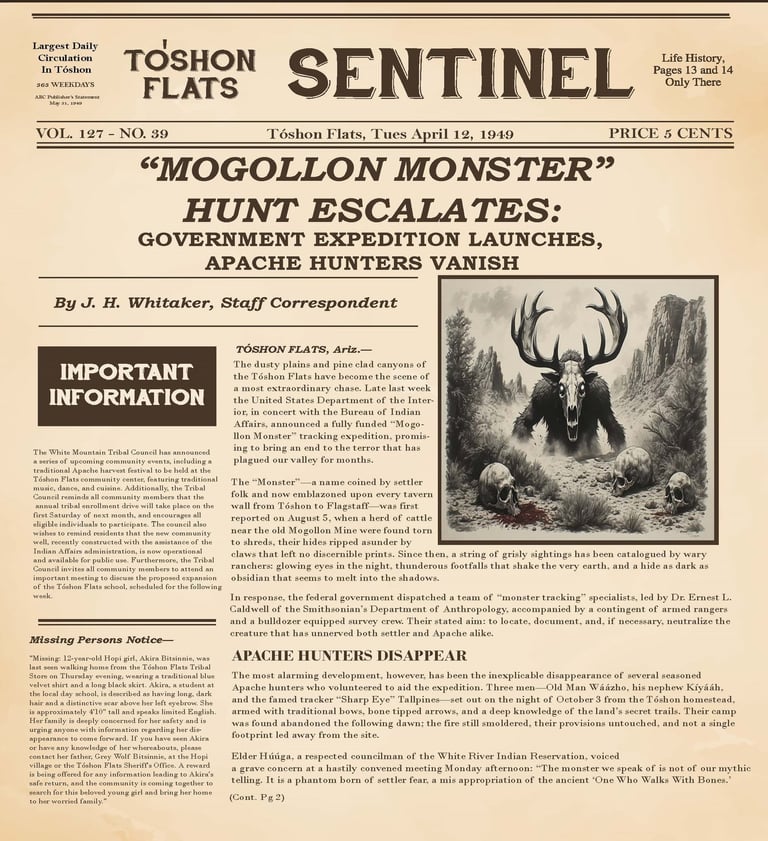
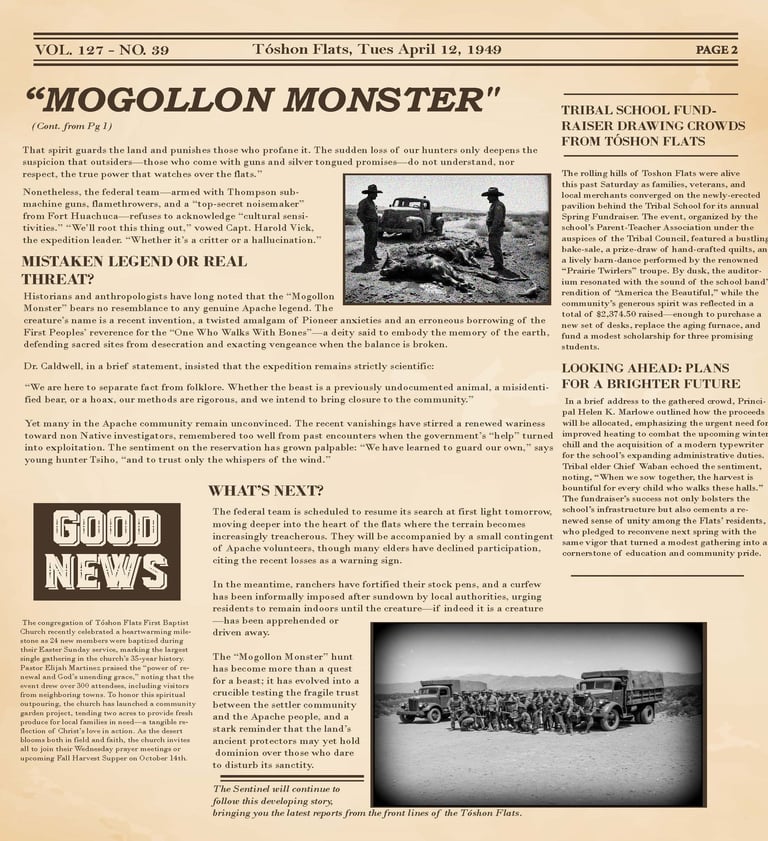
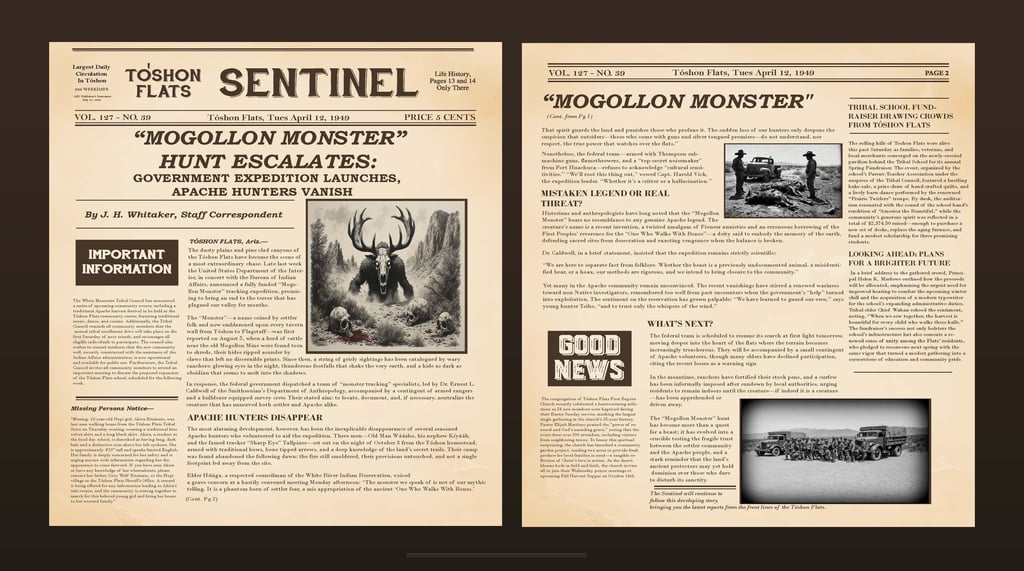
THE TÓSHON FLATS SENTINEL – Tuesday, April 12 1949 – Vol. 127, No. 39
MOGOLLON MONSTER HUNT ESCALATES: Government Expedition Launches, Apache Hunters Vanish
By J. H. Whitaker, Staff Correspondent
Back‑Story as Narrative Engine
That’s why today I’m fleshing out two old newspaper articles—they’re more than filler. They’re the scaffolding that will support the present crisis in my plot.
THE TÓSHON FLATS SENTINEL – Tuesday, April 12 1949 – Vol. 127, No. 39
MOGOLLON MONSTER HUNT ESCALATES: Government Expedition Launches, Apache Hunters Vanish
By J. H. Whitaker, Staff Correspondent
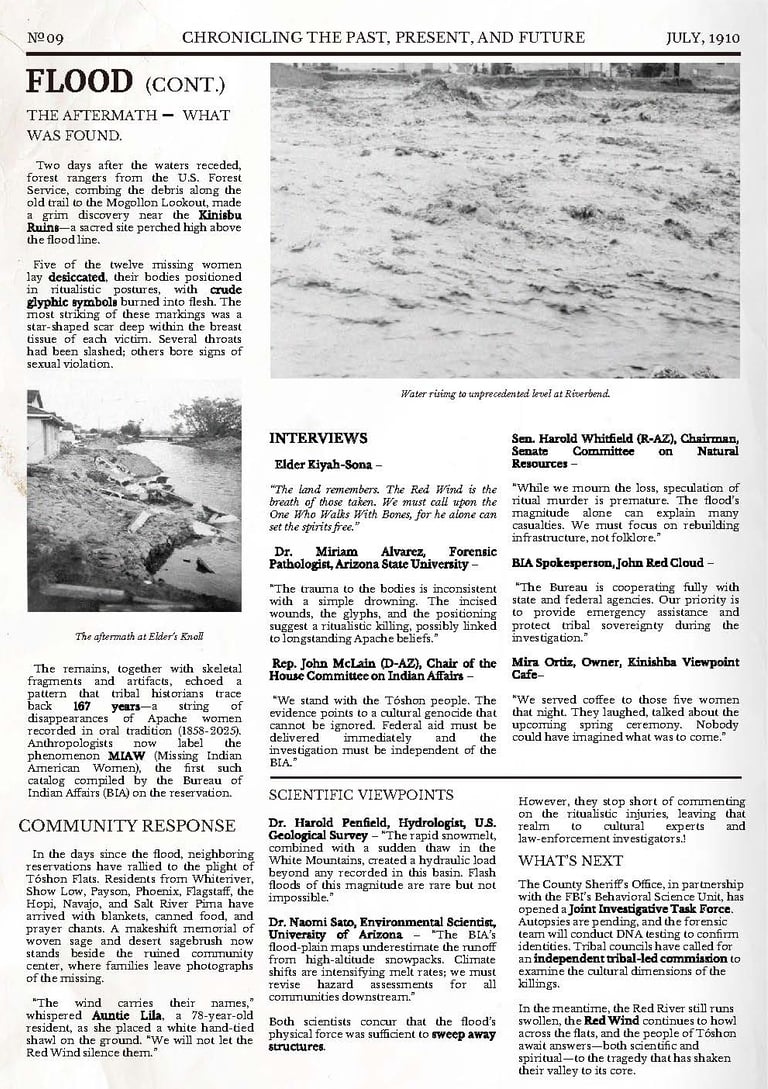
THE TÓSHON FLATS GAZETTE – Friday, 11 February 1962 – Vol. 7, No. 23
MOGOLLON FLOOD TEARS THROUGH TÓSHON FLATS
‘Red Wind’ howls again – Twelve women missing, half the town destroyed
By E. L. “Lenny” Hartman, Staff Reporter
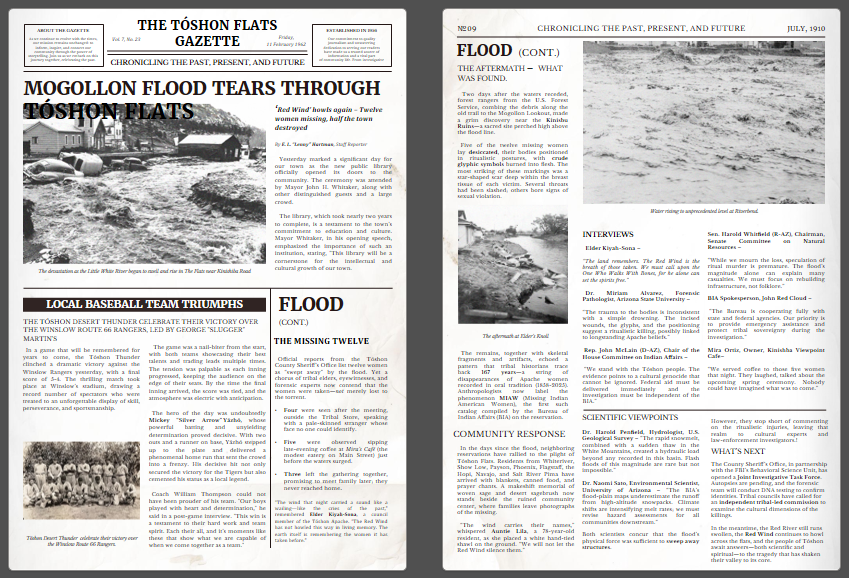
(Read the full articles in the images below—no, I did not actually age the paper with tea and sun! Graphic design is just part of my creative process.)
These headlines become blood‑lines that run through my characters’ grandparents, their town legends, and the whispered warnings that ripple through the present day. When a flood rewrites the map in 1962, the descendants still feel the aftershocks in every cracked road.
Let me know what you think—any details that feel off? Any extra “local color” you’d love to see?
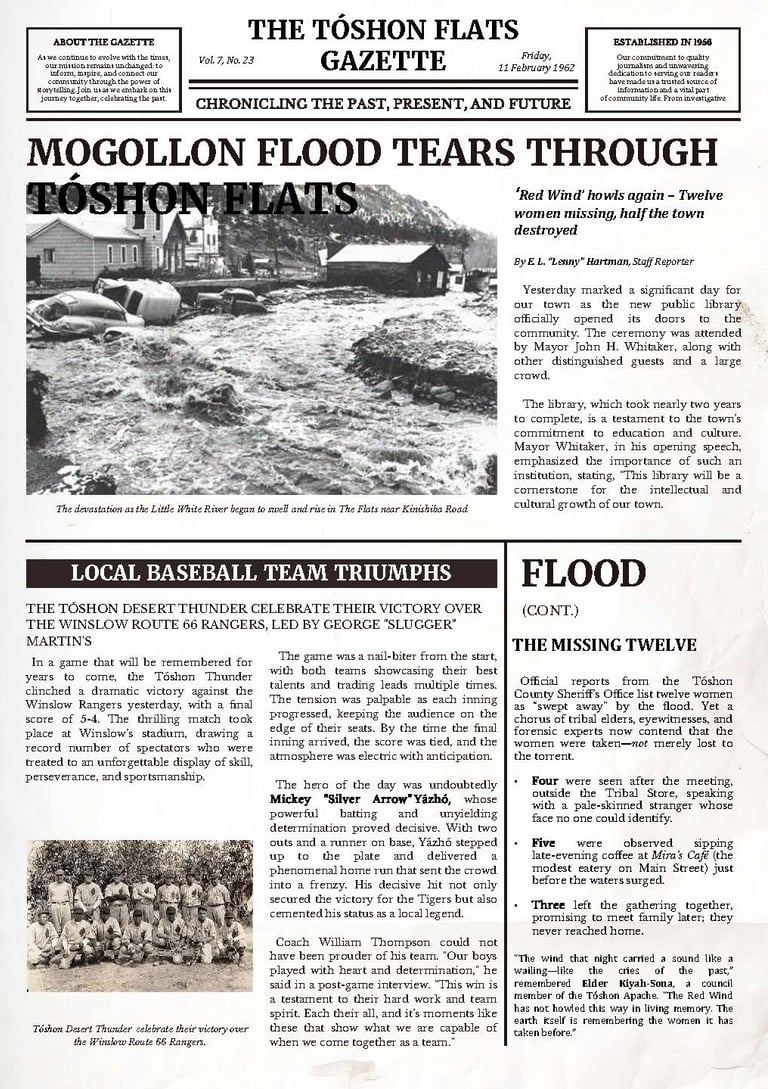
THE TÓSHON FLATS GAZETTE – Friday, 11 February 1962 – Vol. 7, No. 23
MOGOLLON FLOOD TEARS THROUGH TÓSHON FLATS
‘Red Wind’ howls again – Twelve women missing, half the town destroyed
By E. L. “Lenny” Hartman, Staff Reporter
Why this matters:
Historical texture – Readers can flip mental pages, see the town’s trauma, and understand why the “red wind” is more than a metaphor.
Character stakes – My protagonists grew up hearing these stories at the kitchen table; the headlines shape the myths they live by.
Atmospheric continuity – From a 1949 monster hunt to a 1962 flood, each disaster layers the town’s collective memory, making the present‑day mystery feel inevitable.
These snippets are more than headlines—they’re skeleton keys that unlock the town’s collective memory: the frantic scramble for a creature that never was, the relentless flood that turned streets into rivers of sorrow, the whispered rumors of a “Red Wind” that still haunts the pine‑lined horizon.
Next up:
I’ll be drafting a few more newspaper articles, a series of tribal council meeting minutes (1923), clandestine Department of the Interior black-op briefs (1975), a boarding school diary (1952), Police reports (2008), and much more to fill in the gaps between the headline events.
If you’re a fellow writer, archivist, or just love a good desert legend, drop a comment or a 🏜️ below! I’m always hunting for fresh period‑details—whether it’s a typo that slipped through a hot‑press or a colloquial phrase that only a 1950s Arizona farmer would use.
#WorldBuilding #ToshonFlats #WhereTheWindCriesRed #WritingCommunity #IndieAuthors #HistoricalFiction #CreativeResearch #Storytelling #NovelWriting #DustyDunes


GENERAL INQUIRIES
SUBMISSIONS
submissions@obsidianskullpress.com
EDITOR-IN-CHIEF | FOUNDER
tlhutton@obsidianskullpress.com
ARC GROUP
© 2025-2026 Obsidian Skull Press, LLC. All Rights Reserved


Ink & Shadows


Causes we Support






Obsidian Skull Press is dedicated to amplifying transformative narratives through the lens of marginalized global communities. We operate with integrity, transparency, and a fierce commitment to representation.
FOLLOW US
CONTACT US