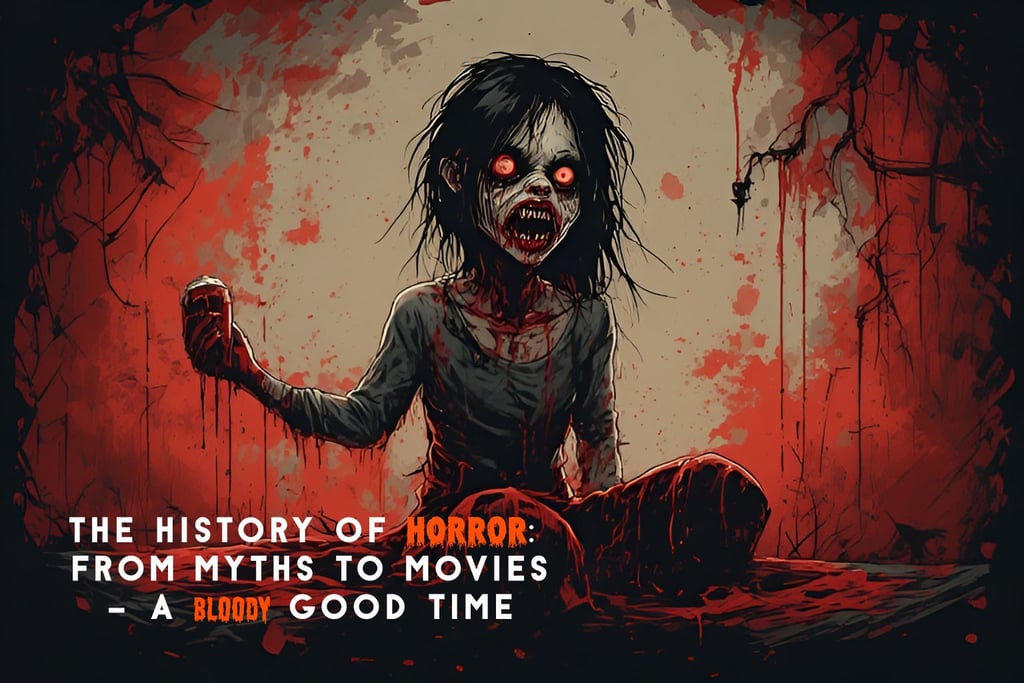
The History of Horror: From Myths to Movies—A Bloody Good Time
By Obsidian Skull Press
5/6/20268 min read
Ah, horror. The genre that has gripped humanity for millennia, making us shiver under blankets by firelight and now, ironically, binge stream it in the glow of our smartphones. From ancient tales to TikTok thrills, horror has always been humanity’s favorite campfire story—minus the s’mores. Let’s dig into its gory roots and see how this genre evolved from shadowy folklore to a $128 billion global industry(Garcia, 2026). ☠️🍿
1. Ancient Origins: When Shadows Had Teeth
Long before Netflix and slasher franchises, horror lived in the mouths of storytellers. The oldest horror myths date back to ancient Mesopotamia, where the Epic of Gilgamesh (c. 2100 BCE) features ferocious beasts and the terrifying forest Humbaba. Meanwhile, in Greek mythology, the Furies haunted Orestes for his matricide, and the Celtic Lady of the Lake tales warned of vengeful spirits.
Japan’s yōkai (supernatural creatures), like the onibaba (ogre hag), were documented in 8th-century scrolls, blending folklore with cautionary horror. These ancient stories weren’t just for scares—they reflected cultural fears: nature’s wrath, the afterlife, and the dangers of hubris.
In the fractured logic of the Aztec cosmos, the Tzitzimime represented the terror of the world’s final sunset. These were skeletal, star-demons—monstrous female deities who dwelled in the darkness of the heavens, waiting for the moment a solar eclipse signaled the collapse of the universe. To the Aztecs, the sky was not merely a void, but a hunting ground where these celestial predators loomed, ready to descend and devour humanity in the blink of a cosmic eye.
Shifting to the shadowed riverbanks of colonial and post-colonial Mexico, the legend of La Llorona transformed the fear of the unknown into a visceral, lingering grief. The "Weeping Woman," condemned to wander endlessly for the drowning of her own children, became the personification of maternal tragedy turned malevolent. Her mournful wail is more than a ghost story; it is a primal warning transmitted through generations, turning the stillness of the night into a psychological trap where the guilt of the past refuses to stay buried.
Crossing into the frozen, unforgiving wilderness of the Great Lakes region, the Algonquian-speaking peoples whispered of the Wendigo. This creature was the ultimate manifestation of the horrors of starvation and the terrifying breakdown of human morality. Described as a gaunt, cannibalistic spirit that grew in size with every bite of human flesh it consumed, the Wendigo served as a chilling metaphor for greed and cannibalism. To become a Wendigo was a fate worse than death—a transformation born of the desperate, icy isolation that turned a neighbor into an unrecognizable, predatory monster.
In the arid landscapes of the American Southwest, the Navajo tradition speaks of the Skinwalker, or yee naaldlooshii. Unlike the mindless hunger of the Wendigo, the Skinwalker represents the horror of subverted intent—a witch who has gained the ability to transform into animals by wearing their pelts. These figures operate within the realm of taboo, representing the corruption of powerful medicine and the violation of social boundaries. They are the shadows that walk on four legs, reminding the listener that the most dangerous monsters are often those that look exactly like the creatures that belong to the natural world.
Further Reading: History.com on Mysteries & Folklore | Japanese Yokai: The Complete Guide to Demons, Spirits & Supernatural Creatures | Native American Legends: Windigo (Wendigo, Windego | Skinwalker (mythology) | Goddesses of the Month: Tzitzimime | La Llorona: An Introduction to the Weeping Woman
2. Gothic Era: Candlelit Chills and Bloody Romance
The 18th century gave birth to Gothic horror, a genre that invented the “haunted house” and the brooding villain. Horace Walpole’s The Castle of Otranto (1764) coined the term “Gothic,” while Ann Radcliffe’s The Mysteries of Udolpho (1794) perfected the “sublime terror” technique—scaring readers without showing the monster.
But it was Mary Shelley’s Frankenstein (1818) that forever changed the genre. Created during a ghost-story contest in the Swiss Alps, the novel explored ethics of creation and the dangers of ambition. Frankenstein’s monster became a pop culture icon, proving that horror could be both intellectually profound and viscerally unsettling.
Case Study: Dracula (1897) by Bram Stoker elevated vampires from folklore to seductive, corrupting beings. Stoker’s research into Eastern European lore laid the groundwork for the “undead” trope still thriving today.
Further Reading: A Research Guide to Gothic Literature in English | Mary Shelley Project
3. 20th Century: Universal Monsters & the Birth of Pop Horror
If the 18th and 19th centuries laid the architectural foundations of horror—with Walpole’s claustrophobic castles, Radcliffe’s atmospheric dread, and Stoker’s predatory aristocrats—it was the 20th century that invited the monsters out of the pages and onto the silver screen. The transition from Gothic literature to "Pop Horror" was defined by a single, revolutionary force: the Universal Studios monster cycle.
From Gothic Ink to Celluloid Icons
The transition began when the brooding, intellectual terror of Mary Shelley’s Frankenstein and the seductive menace of Bram Stoker’s Dracula were handed to directors like James Whale and Tod Browning. In the 1930s, these literary specters were reborn as cinematic icons. Boris Karloff’s lumbering, sorrowful Creature and Bela Lugosi’s hypnotic Count became the new faces of public obsession.
Suddenly, horror was no longer confined to the private, solitary act of reading by candlelight; it was a communal, visceral event. The “universal” appeal of these monsters created a shared cultural language of fear. They were the first true pop-culture celebrities, recognizable in every household, appearing on lunchboxes, posters, and in Saturday matinee serials.
The Anatomy of Pop Horror
What the 20th century mastered was the transformation of the "sublime terror"—the unseen threat—into a tangible, aesthetic experience. This era introduced the "Look": the neck bolts, the widow’s peak, the bandages of the Mummy, and the scales of the Creature from the Black Lagoon. These designs didn’t just scare audiences; they captivated them.
This was the birth of Pop Horror:
The Sympathetic Monster: Following Shelley’s lead, filmmakers emphasized the tragedy of the creature. Audiences didn't just want to see the monster destroyed; they wanted to hear its story.
The Franchise Engine: By turning Dracula and Frankenstein into recurring figures, Universal effectively invented the modern cinematic universe. Horror became a serial commodity.
The Aesthetic Shift: Horror became a visual spectacle, utilizing German Expressionist shadows and elaborate practical effects to create a "fun" kind of nightmare that audiences would pay, again and again, to experience.
The Legacy
The 20th century took the sophisticated, philosophical Gothic tradition and injected it with the high-octane energy of mass media. It proved that the "Monsters" weren't just cautionary tales for the elite, but essential players in a growing global pop culture. From the early black-and-white chills of the 1930s to the slasher phenomena of the late century, the Universal era established the roadmap for how we consume, merchandise, and obsess over our darkest fears.
The monsters didn't just haunt our houses anymore—they moved into our living rooms, becoming the immortal stars of our modern mythology.
Further Reading & Research:
4. Modern Horror: Subtlety Died with the Roar of the Siren
The 1980s–2000s saw horror split into sub-genres: slasher films (A Nightmare on Elm Street), body horror (The Thing), and psychological thrillers (The Shining). Stephen King’s The Shining (1977) became the ultimate adaptation battleground, with Stanley Kubrick’s 1980 film diverging wildly from the book—a testament to horror’s malleability.
Today, horror is more diverse and experimental. Jordan Peele’s Us (2019) used horror to critique class inequality, while games like Amnesia: The Dark Descent (2010) and the Resident Evil Series masterfully used environmental tension. Even TikTok has birthed trends like the “jumpscare” challenge, proving horror’s adaptability.
Case Study: Resident Evil (1996) turned survival horror into a billion-dollar franchise. Its claustrophobic mansion and iconic Tyrant enemies (like Nemesis) set gaming’s gold standard for terror.
Further Reading: The Rise of Horror in Interactive Media: Video Games and VR | Jordan Peele: Reshaping Horror Through Social Commentary
5. Why Horror Endures: Screams in 2026
Horror isn’t just about jump scares—it’s a mirror for society’s anxieties. Pandemics (2008’s 28 Weeks Later), climate collapse (2021’s The Wretched), and AI dread (2022’s The Creator) all get a bloody sendoff in the genre. Plus, horror is profitable: Silent Hill 2 sold 2.5 million units in 2024 alone, and Evil Dead Rise raked in $40 million in its opening weekend.
Final Case Study: Hereditary (2018) reinvented the “family horror” trope with its haunting blend of grief and ritual. Writer-director Ari Aster called it “a story about trauma,” showing that horror never loses its soul when it connects to real human pain.
Ready to Step into the Shadows?
Whether you’re a die-hard fan or a casual viewer, the history of horror is a blood-soaked odyssey of creativity. Check out our curated list of classic horror reads and must-play horror games, The Anatomy of Dread: A Curator’s Guide to the Sublime Terror, to dive deeper.
Because really—what’s life without a little terror? 😈📚
Follow us on Facebook for daily doses of the macabre. Are you ready to scream with the crowd?
References:
Garcia, I. (2026, May 6). Horror dominates film industry amid rising social anxieties. The Mirror. https://vnhsmirror.com/227152/entertainment/horror-dominates-film-industry-amid-rising-social-anxieties/
Mysteries & Folklore: Definition and Stories | HISTORY. (n.d.). HISTORY. https://www.history.com/topics/folklore
Lebreton, J. (2025, October 31). Japanese Yokai: The Complete Guide to Demons, Spirits & Supernatural Creatures. Wallango. https://wallango.com/blogs/news/japanese-yokai-the-ultimate-guide?srsltid=AfmBOooKNlWol8Ofnn1bnC9u7BT_lnH-aUDBbg-2MOkPfi3gNDjmDD7y
Windigo, the Ice Cannibal (Wendigo, wiindigoo, Windgo, Windego). (n.d.). https://www.native-languages.org/windigo.htm
Skinwalker (mythology) | Religion and Philosophy | Research Starters | EBSCO Research. (n.d.). EBSCO. https://www.ebsco.com/research-starters/religion-and-philosophy/skinwalker-mythology#skinwalker-mythology
Goddesses of the Month: Tzitzimime. (n.d.). https://www.mexicolore.co.uk/aztecs/gods/goddesses-of-the-month-tzitzimime
Winick, S. (2021, October 13). La Llorona: An introduction to the Weeping Woman | Folklife Today. The Library of Congress. https://blogs.loc.gov/folklife/2021/10/la-llorona-an-introduction-to-the-weeping-woman/
bloomsbury.com. (n.d.). A Research guide to Gothic Literature in English. Bloomsbury. https://www.bloomsbury.com/us/research-guide-to-gothic-literature-in-english-9781442277489/
mary|shelley|project. (n.d.). The Mary Shelley Project. https://themaryshelleyproject.weebly.com/
The Project Gutenberg eBook of the Castle of Otranto, by Horace Walpole. (n.d.). https://www.gutenberg.org/files/696/696-h/696-h.htm
The Mysteries of Udolpho by Ann Ward Radcliffe. (2022, December 1). Project Gutenberg. https://www.gutenberg.org/ebooks/3268
The Project Gutenberg eBook of Frankenstein, by Mary Shelley. (n.d.). https://www.gutenberg.org/files/41445/41445-h/41445-h.htm
Dracula by Bram Stoker. (2025, September 24). Project Gutenberg. https://www.gutenberg.org/ebooks/345
Bfi. (2017, June 6). Where to begin with the Universal horror cycle. BFI. https://www.bfi.org.uk/features/where-begin-universal-horror-cycle
Lugowski, D. (2000, April 1). Whale, James. https://www.sensesofcinema.com/2005/great-directors/whale/
Unspeakable: The films of Tod Browning. (n.d.). Film at Lincoln Center. https://www.filmlinc.org/series/unspeakable-the-films-of-tod-browning/
Carlotta, A. (2025, September 26). Biography of Boris Karloff (AKA Frankenstein!) — ANTONIA CARLOTTA PRESENTS UNIVERSALLY ME. ANTONIA CARLOTTA PRESENTS UNIVERSALLY ME. https://www.antoniacarlotta.com/home/boris-karloff
Weiner, V. a. P. B. D. (2024, November 1). Bela Lugosi: ‘Dracula’ and a Family Legacy. IT CAME FROM. . . https://itcamefromblog.com/2024/02/24/bela-lugosi-dracula-and-a-family-legacy/
Debunk File. (2025, October 31). The Original Cinematic Universe | Full Documentary film [Video]. YouTube. https://www.youtube.com/watch?v=mq0sTEaHZCc
The Monster Show: A Cultural History of horror. (n.d.). Goodreads. https://www.goodreads.com/book/show/79089.The_Monster_Show
Watch A Nightmare on Elm Street | Netflix. (n.d.). https://www.netflix.com/title/806456
Watch The Thing | Netflix. (n.d.). https://www.netflix.com/title/1038926
Stephen King | The Shining. (n.d.). https://stephenking.com/works/novel/shining.html
IMDb. (n.d.). Stanley Kubrick. IMDb. https://www.imdb.com/name/nm0000040/
US (2019) ⭐ 6.8 | Horror, mystery, Thriller. (2019, March 22). IMDb. https://www.imdb.com/title/tt6857112/
Amnesia: The Dark Descent on Steam. (n.d.). https://store.steampowered.com/app/57300/Amnesia_The_Dark_Descent/
Resident Evil Franchise sale. (2022, April 25). https://store.steampowered.com/sale/resident-evil
!!️BIG KWASII!!️ THEE MOMENT😘✨ on TikTok. (n.d.). TikTok. https://www.tiktok.com/@iiamkwasii/video/7432112026907921695
adminHQ. (2026, March 20). The rise of horror in interactive media: video games and VR - THE HORROR ENTERTAINMENT MAGAZINE. THE HORROR ENTERTAINMENT MAGAZINE. https://www.screamhorrormag.com/the-rise-of-horror-in-interactive-media-video-games-and-vr/
Jordan Peele: Reshaping Horror through Social Commentary. (n.d.). The Roar. https://piedmontroar.com/7484/sliderposts/jordan-peele-reshaping-horror-through-social-commentary/
28 Weeks Later (2007) ⭐ 6.8 | Horror, Sci-Fi. (2007, May 11). IMDb. https://www.imdb.com/title/tt0463854/
The Wretched (2019) ⭐ 5.8 | Drama, horror, mystery. (2020, May 1). IMDb. https://www.imdb.com/title/tt8305806/
The Creator (2023) ⭐ 6.7 | Action, adventure, Drama. (2023, September 29). IMDb. https://www.imdb.com/title/tt11858890/
SILENT HILL 2 on Steam. (n.d.). https://store.steampowered.com/app/2124490/SILENT_HILL_2/
Evil Dead Rise (2023) ⭐ 6.5 | Horror. (2023, April 21). IMDb. https://www.imdb.com/title/tt13345606/
Watch Hereditary | Netflix. (n.d.). https://www.netflix.com/title/80238910
GENERAL INQUIRIES
SUBMISSIONS
submissions@obsidianskullpress.com
EDITOR-IN-CHIEF | FOUNDER
tlhutton@obsidianskullpress.com
ASSISTANT EDITOR
devon.k@obsidianskullpress.com
ARC GROUP
© 2025-2026 Obsidian Skull Press, LLC. All Rights Reserved
Ink & Shadows


Causes we Support







Obsidian Skull Press is dedicated to amplifying transformative narratives through the lens of marginalized global communities. We operate with integrity, transparency, and a fierce commitment to representation.
Cultura Nocturna ARC Group
FOLLOW US
CONTACT US


Author Services